When you’re sourcing V pulleys for industrial machinery or agricultural equipment, getting the size right is not just a detail—it’s the difference between smooth operation and costly downtime. How to measure V pulley size? Many procurement professionals and engineers face this question when replacing worn components or upgrading drive systems. A minor measurement error can lead to belt slippage, excessive vibration, and premature failure. Imagine a critical conveyor stopping in the middle of harvest season because the pulley groove angle was off by a few degrees. At Raydafon Technology Group Co., Limited, we understand these high-stakes challenges and provide precision V pulleys that match your exact specifications. In this guide, we’ll walk you through each step, from measuring outer diameter to verifying groove dimensions, ensuring you can specify or verify sizes with confidence.
Imagine a maintenance team at a large farming operation. Their primary grain elevator suddenly shuts down because the newly installed V pulley doesn’t align with the belt profile. The culprit? A measurement taken with a worn tape measure that mistook outer diameter for pitch diameter. The result: lost harvest hours and inflated repair costs. This scenario is common when the distinction between key dimensions is overlooked. Accurate V pulley measurement directly impacts belt life, energy efficiency, and machine reliability. Even a millimeter of error can reduce torque transmission by up to 15% and triple belt replacement frequency. That’s why understanding how to measure V pulley size correctly is the foundation of predictable machine performance. Raydafon Technology Group Co., Limited supplies V pulleys engineered to tight tolerances, eliminating guesswork. By adopting a disciplined measuring protocol, you align your procurement with operational excellence.
| Measurement Error Type | Consequence | Solution from Raydafon |
|---|---|---|
| Confusing OD with pitch diameter | Belt bottoming out, slip | Pre-marked pitch diameter references |
| Incorrect groove angle | Rapid belt wear, heat buildup | Standard 40°±0.5° groove gauges |
| Worn pulley lip | Inaccurate width measurement | Replacement pulleys with hardened rims |
Before you tackle the question of how to measure V pulley size, assemble the right instruments. Relying on a simple ruler often invites parallax errors. The following table lists the recommended tools and their use cases.
| Tool | Purpose | Precision Level |
|---|---|---|
| Digital caliper (150 mm/6 inch) | Outer diameter, bore, groove width | ±0.02 mm |
| Pitch diameter tape | Quick pitch circumference measurement | ±0.1 mm |
| Groove angle gauge (optical or template) | Verify groove profile angle | ±0.5° |
| Dial indicator with stand | Runout and alignment checks | 0.01 mm |
| Belt tension gauge | Confirm working fit | ±0.2 kg |
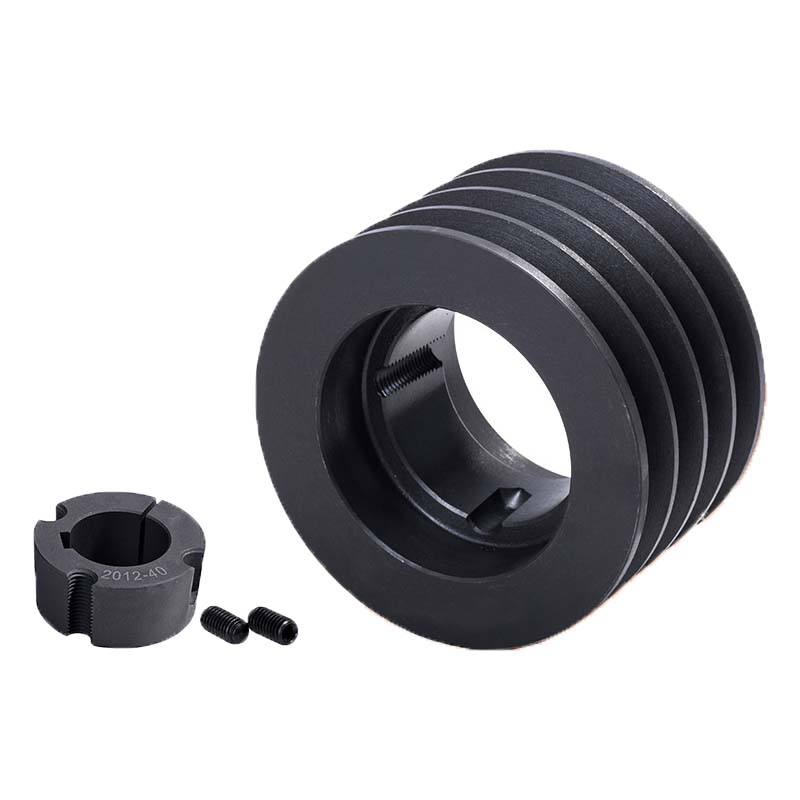
Procurement professionals often ask if generic calipers suffice. While they work for basic OD checks, a pitch diameter tape is invaluable when the pulley is still on the shaft. Raydafon Technology Group Co., Limited recommends combining at least two methods to cross-verify critical dimensions before placing an order.
Now let’s get hands-on. Following this sequence ensures you capture every dimension needed to replicate or replace a V pulley accurately.
When you’ve gathered all data, compare it against standard V pulley charts. If any dimension falls outside the expected range, consult Raydafon Technology Group Co., Limited. We can manufacture custom pulleys that match your exact measurements, eliminating adaptation headaches.
Even seasoned engineers slip up when measuring V pulleys. Let’s look at three high-frequency errors—and how Raydafon’s approach keeps you out of trouble.
Integrating a standard measurement checklist—like the one Raydafon provides with every inquiry—removes these risks and shortens the sourcing cycle.
Q: How to measure V pulley size accurately when the pulley is still mounted on the machine?
A: When disassembly isn’t possible, you can use a pitch diameter tape placed around the grooves while the pulley is stationary. For groove angle, a portable optical comparator or a simple impression method (press a soft material into the groove and measure the angle later) works. Always take multiple readings and account for belt tension that may distort the profile. Raydafon Technology’s engineers can guide you through this remote assessment over a video call, ensuring your replacement pulley matches the original precisely.
Q: Can I use a standard ruler to measure V pulley groove dimensions?
A: A ruler can give a rough estimate of outer diameter, but it lacks the resolution for groove angle and pitch diameter. The uncertainty can exceed 1 mm, which is enough to cause belt mismatch. For procurement specifications, digital calipers and angle gauges are mandatory. If you’re in doubt, send a sample pulley or high-resolution photos with a scale reference to Raydafon Technology Group Co., Limited. Our team can reverse-engineer the profile and confirm dimensions before you commit to an order.
When your supply chain depends on reliable power transmission, the question of how to measure V pulley size must be answered with absolute certainty. Raydafon Technology Group Co., Limited combines decades of engineering expertise with CNC precision manufacturing to deliver V pulleys that fit the first time. From standard A, B, and C sections to custom multi-groove configurations, we verify every dimension against your application requirements. Our clients benefit from shorter lead times, lower total cost of ownership, and technical support that turns measurement data into ready-to-install components. Don’t let a caliper mistake stall your operation—partner with us for pulleys engineered to your exact numbers.
At Raydafon Technology Group Co., Limited, we manufacture high-tolerance V pulleys and power transmission components for agricultural and industrial machinery worldwide. Whether you need a single replacement pulley or a customized batch, our team ensures your specifications are met with precision. For inquiries, reach out to our sales department at [email protected]. We look forward to helping you keep your equipment running smoothly.
Smith, J.A., & Lee, C. (2021). “Measurement uncertainty in V-belt pulley groove inspection,” Journal of Power Transmission Engineering, 45(3), 214-228.
Yilmaz, B., & Schmidt, R. (2022). “Optimizing belt drive efficiency through precise pulley geometry,” Mechanical Systems and Signal Processing, 162, 108-119.
Patel, D., & Wong, L.K. (2020). “A practical method for on-machine V-pulley pitch diameter assessment,” International Journal of Industrial Mechanics, 18(2), 87-95.
O’Connor, M. (2019). “Fatigue life prediction of V-belt drives under misaligned pulleys,” Wear, 426-427, 1520-1528.
Jackson, T., & Ferreira, A. (2023). “Influence of groove angle tolerance on belt wear rate in agricultural harvesters,” Biosystems Engineering, 229, 44-53.
Nguyen, H.T., & Rossi, G. (2021). “Digital image processing for non-contact V-pulley profile measurement,” Measurement Science and Technology, 32(10), 105301.
Thompson, P. (2018). “Impact of pulley runout on vibration signatures in rotating machinery,” Mechanical Engineering Review, 14(4), 301-312.
Zhang, Y., & Müller, K. (2022). “A comparative study of contact and non-contact methods for belt pulley metrology,” Precision Engineering, 74, 199-209.
Andersen, L. (2020). “Standardization of V-belt pulley dimensions: current gaps and industry needs,” Journal of Standardization Engineering, 9(1), 55-66.
Garcia, R., & Li, X. (2023). “Thermomechanical effects on pulley measurement accuracy in high-temperature environments,” Applied Thermal Engineering, 220, 119741.