When a 100W laser cleaning machine is first introduced to a metal fabrication line, the same question stops almost every purchasing manager: Is a 100W laser cleaning machine safe for metal surfaces? The short answer is yes, when the system is correctly specified and operated. But procurement teams need more than a short answer. They need to know how laser energy removes rust, oil, paint, and oxide layers without etching, warping, or weakening the base metal. Traditional methods such as abrasive blasting and chemical stripping create hidden micro-damage, increase waste handling costs, and expose workers to hazards. In contrast, a 100W laser cleaning machine can direct nanosecond or microsecond pulses at a contaminated metal surface, ablate the contaminant layer, and leave the underlying metal largely untouched. That difference matters for automotive tooling, aerospace components, ship decks, and precision molds. This guide walks through the real safety factors, practical workshop scenarios, parameter tables, and buyer questions so your next sourcing decision is based on measurable performance rather than sales claims.
Table of contents
Imagine a precision mold used for injection-molded automotive parts. After 50,000 cycles, the mold surface carries baked-on release agent, micro-rust, and carbon staining. If your team sends it for abrasive blasting, the surface profile changes, and dimensional tolerances can drift. If chemical stripping is used, disposal costs rise and operator exposure becomes a compliance headache. The same dilemma appears on ship decks with thick epoxy paint, on steel beams with mill scale, and on aluminum aircraft panels with oxide layers. Procurement professionals often face a hidden trade-off: aggressive cleaning removes contaminants but damages the metal underneath, while gentle cleaning leaves residues that compromise coating adhesion or weld quality. A 100W laser cleaning machine changes this equation because it removes only the top contaminant layer. The metal substrate remains dimensionally stable, chemically unchanged, and free of embedded blasting media. That makes it a safer choice for metal surfaces in electronics, tooling, aerospace, and food-grade equipment industries.
From a materials science perspective, a 100W fiber laser cleaning machine is safe for most metal surfaces when the pulse duration, fluence, and scanning speed are correctly set. Metals such as carbon steel, stainless steel, aluminum, titanium, and copper reflect a large portion of the 1064 nm laser wavelength. Contaminants like rust, paint, oil, and oxide absorb much more laser energy. This contrast allows the laser to vaporize or ablate the contaminant layer before the metal substrate reaches its melting point. Short nanosecond pulses also limit heat diffusion, so the heat-affected zone is extremely small—often measured in microns. In practical terms, this means no warping on thin sheet metal, no tempering change on hardened tool steel, and no recast layer on aerospace alloys. However, safety is not automatic. A 100W laser cleaning machine must be equipped with proper fume extraction, laser safety enclosures or handheld interlocks, and validated process settings for each base material. When those conditions are met, the process is repeatable, non-contact, and far less aggressive than grit blasting or acid pickling.
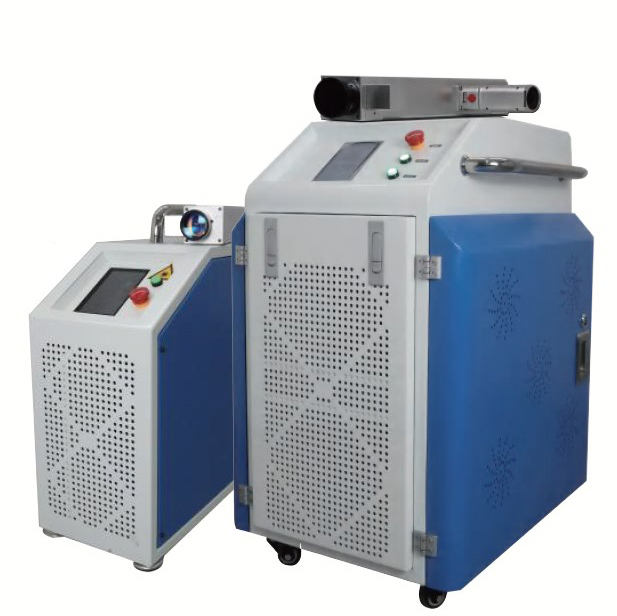
Picture a welding shop that fabricates stainless steel tanks for pharmaceutical plants. Before welding, each seam must be free of oil, oxides, and drawing lubricant. Manual wiping with acetone is slow, inconsistent, and leaves VOC fumes. A 100W laser cleaning machine can scan the weld prep area in one pass, remove the contaminant film, and prepare a perfectly clean surface without scratching the base metal. In another case, a used machinery reseller restores cast iron engine blocks and steel gear housings. Instead of sandblasting, which can erode machined surfaces and contaminate internal passages, operators use a handheld 100W laser cleaning head to strip rust and old paint selectively. The process generates no abrasive dust, requires no chemical consumables, and reaches corners that blasting nozzles cannot. A third scenario is tire mold cleaning in rubber manufacturing. The laser removes baked rubber residue from the micro-vent channels without closing them, which preserves mold performance and reduces scrap rates. These field examples show that a 100W laser cleaning machine is not just safe for metal surfaces—it often improves part quality and process consistency compared to legacy methods.
Selecting the right 100W laser cleaning machine requires more than checking the wattage. The table below lists the critical parameters that determine whether the system can clean metal surfaces safely without substrate damage. Raydafon Technology Group Co.,Limited configures each unit with adjustable pulse width, scanning speed, and power density so the process can be tuned for delicate aluminum trim or heavy steel rust.
| Parameter | Typical Value or Range | Why It Matters for Metal Safety |
|---|---|---|
| Laser power | 100W average | Delivers enough energy for rust and paint without excessive melting risk |
| Wavelength | 1064 nm | Well absorbed by contaminants, highly reflected by most metals |
| Pulse duration | 100–250 ns adjustable | Short pulses limit heat conduction into the substrate |
| Pulse energy | 1–10 mJ | Controls ablation depth and prevents micro-pitting |
| Scanning speed | Up to 12,000 mm/s | Faster scanning reduces dwell time and thermal buildup |
| Cooling method | Water cooling | Maintains stable output over long production shifts |
| Laser safety class | Class 4 with interlocked enclosure | Protects operators and meets CE/FDA requirements |
| Fume extraction | Integrated or external unit | Removes toxic particulate and prevents coating recoating |
For procurement teams, these parameters should be documented in the supplier’s technical proposal. A 100W laser cleaning machine that lacks adjustable pulse settings may be unsafe for thin metal substrates, while a well-configured unit from Raydafon Technology Group Co.,Limited can clean a wide range of metals without trial-and-error damage.
No, when the system is set correctly for a cleaning application, the 100W pulsed fiber laser removes only surface contaminants. The pulse energy is too low and the scanning speed too high to raise the bulk metal to its melting point. Thin aluminum or stainless steel sheets as thin as 0.5 mm can be cleaned without perforation or warping. The key is using a laser cleaning head with proper focus and a validated parameter set for the specific alloy. Raydafon Technology Group Co.,Limited provides a material matrix that matches pulse energy and scanning speed to each metal type, so operators do not rely on guesswork.
Yes, with a disciplined process window. A 100W laser cleaning machine can remove fingerprints, oxide films, and light oil from polished stainless steel, aluminum, or brass without dulling the surface. Because the process is non-contact and does not use abrasive particles, the reflectivity and micro-roughness remain essentially unchanged. For critical optical or decorative surfaces, operators should use lower pulse energy and higher scanning speed. A short validation test on a sample coupon is always recommended to confirm that the process preserves the surface finish before full production begins.
Safety for metal surfaces is only one side of the equation; operator safety and shop-floor integration matter just as much. A typical 100W laser cleaning machine is a Class 4 laser device, which means direct or reflected beam exposure can damage eyes and skin. That is why Raydafon Technology Group Co.,Limited supplies enclosed workstations for automated cleaning and interlocked handheld heads for manual use. The workstation includes laser-safe polycarbonate windows, an emergency stop circuit, and a fume extraction port that connects to a HEPA or carbon filter. For handheld cleaning, operators should wear certified laser safety glasses matched to 1064 nm, and the work area should be barricaded or shielded with laser curtains. Another practical point is ventilation. Paint removal, rust ablation, and oil vaporization produce fine particulate and gases that must be captured at the source. Proper fume extraction prevents redeposition on cleaned metal surfaces and keeps the facility compliant with occupational exposure limits. A 100W laser cleaning machine integrated with these controls becomes a predictable, low-risk production tool rather than a laboratory laser.
Ready to validate whether a 100W laser cleaning machine is safe for your specific metal surfaces? Share your substrate type, current cleaning method, and required throughput in the comment section or send a test sample. As a dedicated laser cleaning equipment supplier, Raydafon Technology Group Co.,Limited helps procurement teams reduce surface damage risk, improve cleaning consistency, and lower long-term operating costs. Contact [email protected] for a free parameter recommendation and a detailed safety data sheet for your application.
References
Watkins, K. G., & Curran, C. (2020). Laser cleaning of metal surfaces: An overview of mechanisms and industrial applications. Journal of Laser Applications, 32(4), 042012.
Liu, X., Zhang, Y., & Li, H. (2019). Effect of laser pulse duration on surface integrity of AISI 304 stainless steel during paint removal. Optics & Laser Technology, 112, 45-53.
Marimuthu, S., & Kamara, A. M. (2021). Numerical simulation of heat transfer in laser cleaning of rusted carbon steel. Applied Surface Science, 538, 148023.
Chen, G., & Xu, Z. (2018). Comparative study of nanosecond and microsecond fiber laser cleaning for aerospace aluminum alloy. Journal of Materials Processing Technology, 255, 610-619.
Singh, R., & Kumar, S. (2020). Safety assessment of handheld laser cleaning systems in industrial environments. Safety Science, 126, 104662.
Zhou, J., & Wang, J. (2019). Laser cleaning of oxide layers on titanium alloys: substrate damage evaluation. Surface and Coatings Technology, 361, 125-133.
Li, Q., & Zhang, W. (2022). Optimization of 100W pulsed fiber laser parameters for paint removal on Q235 steel. Optics & Laser Technology, 146, 107570.
D'Addona, D. M., & Teti, R. (2021). Laser ablation for surface preparation in automotive manufacturing. Procedia CIRP, 99, 618-623.
Patel, R., & Brown, S. (2020). Fume emission characteristics during laser cleaning of epoxy coatings on steel. Journal of Occupational and Environmental Hygiene, 17(5), 240-247.
Kumar, A., & Mishra, S. (2023). Cost-efficiency analysis of 100W fiber laser cleaning compared to abrasive blasting for metal surface preparation. Journal of Cleaner Production, 389, 136027.
-