Imagine walking onto your packaging floor and seeing piles of product waiting to be wrapped, while your current machine struggles to keep up. Downtime, film jams, and inconsistent seals are eating into your margins. As a procurement manager, you know that choosing the right shrink wrap machine can make or break your production efficiency. But with so many options, the first question inevitably arises: “What are the different types of shrink wrap machines available?” From manual L-sealers for low-volume startups to high-speed fully automatic sleeve wrappers for 24/7 lines, the shrink wrap machinery landscape can be overwhelming. Each type serves a distinct application, film requirement, and throughput need. At Raydafon Technology Group Co.,Limited, we’ve guided hundreds of buyers through this decision, helping them match machine type to real-world workflow without overspending. In this guide, we’ll break down every major shrink wrap machine category, share pain-point scenarios, compare key specifications, and answer the questions our clients ask most. By the end, you’ll have the clarity to request the right quotation and avoid costly mismatches.
Before diving into the different types, it’s essential to understand what a shrink wrap machine does. In simple terms, it applies heat to a polymer film, causing it to shrink tightly around a product. The process involves two core functions: wrapping the product in film and then applying heat via a shrink tunnel or heat gun. The pain point many buyers face is assuming that one machine can handle all products. For instance, a food manufacturer packing trays of fresh produce realized that their L-sealer was leaving weak corner seals due to film bunching, leading to contamination. The solution was switching to a side-sealing machine with a more uniform film feed, drastically reducing waste.
The bond between film chemistry and machine design is vital. PVC films require lower temperatures and shorter dwell times, while polyolefin films need precise temperature control but offer stronger seals. At Raydafon Technology Group Co.,Limited, we often start by analyzing your product dimensions, film preference, and production speed to recommend the right category. This upfront clarity avoids the common pitfall of buying a machine that underperforms or overheats, causing film melting. The table below summarizes the relationship between machine type and film compatibility, a critical factor often overlooked by first-time buyers.
| Machine Type | Ideal Film Types | Typical Temperature Range |
|---|---|---|
| Manual L-Sealer | PVC, Polyolefin (centerfold) | 120°C – 150°C |
| Chamber Machine | Polyethylene, PVC | 140°C – 180°C |
| Automatic Side Sealer | Polyolefin, Polyethylene (folded or single-wound) | 150°C – 200°C |
A common sourcing headache: you buy a manual machine to save costs, only to find your operator can’t keep up with order volume. That exactly describes a startup electronics assembler who chose a manual L-sealer, then had to hire two extra staff within months. The solution was upgrading to a semi-automatic model with a powered takeaway conveyor, which tripled packaging speed without a full automation budget. This scenario highlights why it’s crucial to understand the automation levels. Manual machines rely on the operator to place the product, pull the film over it, and activate the seal. Semi-automatic machines automate the seal or shrink steps, while the product is still manually loaded. Fully automatic machines integrate product infeed, film wrapping, sealing, and shrinking into a continuous, hands-free line.
Raydafon Technology Group Co.,Limited helps clients calculate the true cost of labor versus machine investment. For a stationery manufacturer, we demonstrated that a semi-automatic side sealer would pay for itself in 8 months through reduced overtime. The table below distills the key differentiators, which often resolve the “What are the different types of shrink wrap machines available?” question at the operational level.
| Feature | Manual | Semi-Automatic | Fully Automatic |
|---|---|---|---|
| Operator Involvement | Full manual operation | Partial automation; manual loading | Integrated line; minimal labor |
| Speed (packages/hour) | 100 – 300 | 300 – 1000 | 1000 – 3000+ |
| Film Waste | Moderate | Low – Moderate | Very Low |
| Best For | Startups, low volume, mixed sizes | Mid-volume, standard products | High-volume, uniform products |
Chamber-style machines are a favorite for packaging irregular shapes or heavy items that can’t pass through a standard L-sealer. Picture a distribution center wrapping bundles of books: the stacks were too tall for a side seal, and the irregular edges caused film tears. A chamber machine, where the entire product is placed inside a sealed chamber and film is draped over it before shrinking, solved the problem instantly. The enclosed environment ensures that the heat is retained, allowing thicker films like polyethylene to shrink uniformly without burning the corners.
These machines are available in semi-automatic and automatic versions. A key specification is the chamber size; a machine with a 24” x 18” x 12” chamber can handle most retail bundles. However, cycle time is longer—typically 15–30 seconds per batch—making it suitable for lower throughput lines (300–500 packs/hour). Buyers often ask, “What are the different types of shrink wrap machines available for heavy or tall products?” Chamber machines are the answer, and Raydafon Technology Group Co.,Limited offers models with reinforced sealing frames to withstand thick gauge films, a detail that prevents bowing and premature wear.
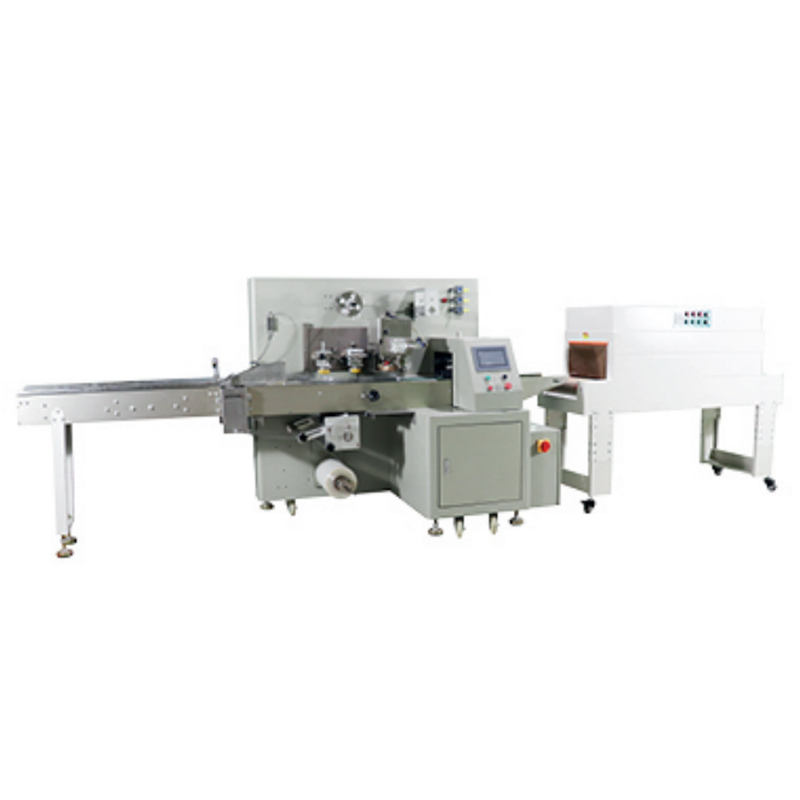
L-sealers are named for the L-shaped sealing bar that simultaneously creates the end seal and the side seal in one motion. They are the workhorse of entry-level shrink packaging. However, many users complain about film waste when wrapping products of varying lengths. Side sealers address this by continuously feeding film and sealing only the sides, with an inline or separate cross-seal unit. This design dramatically reduces film usage—by up to 20%—and improves consistency. A cosmetics manufacturer switched from an L-sealer to a side sealer and reduced film costs by $3,500 annually.
When clients ask, “What are the different types of shrink wrap machines available to cut film expenses?” our Raydafon specialists immediately point to the side sealer’s efficiency. Below is a comparison of common specs for L-sealers and side sealers.
| Parameter | L-Sealer (Semi-Auto) | Side Sealer (Automatic) |
|---|---|---|
| Max Product Width | 16” – 24” | Up to 30” |
| Sealing Type | Momentary impulse | Continuous hot-knife or impulse |
| Film Input | Centerfolded film only | Single-wound or centerfold |
| Ideal for Changing Sizes | Limited | Excellent, with minimal changeover |
Shrink tunnels are the heating chambers that do the actual shrinking after wrapping. Choosing the wrong tunnel design is a frequent misstep. A food co-packer used a batch-style tunnel for a high-speed line; the stop‑and‑go operation caused temperature fluctuations that led to inconsistent shrink on PET bottles. The fix was a conveyorized tunnel with precise PID temperature control and adjustable airflow. Conveyor tunnels move products through steadily, ensuring even heat distribution, while batch tunnels (often part of chamber machines) shrink a full load at once.
For operations where throughput exceeds 800 packs/hour, a continuous tunnel is non‑negotiable. Raydafon Technology Group Co.,Limited integrates tunnels with industry‑leading insulation and recirculating air systems that cut energy use by 15% compared to older models. Key parameters to evaluate include tunnel opening dimensions, conveyor speed (0–10 m/min adjustable), and maximum temperature (up to 250°C). The table below clarifies tunnel options.
| Tunnel Type | Best Throughput | Typical Dimensions (LxWxH opening) | Energy Efficiency |
|---|---|---|---|
| Batch Chamber | 300 – 500 packs/hr | 24” x 16” x 12” | Moderate |
| In‑Line Conveyor (compact) | 500 – 1,500 packs/hr | 36” x 20” x 10” | High (with recirculation) |
| High‑Speed Conveyor | 1,500 – 4,000 packs/hr | 60” x 24” x 12” | Very High |
Beyond the standard categories, specialty shrink wrappers address niche applications. Sleeve wrappers are designed for tall, cylindrical products like bottles or cans; they wrap a band of film around the entire product and shrink it, creating a tamper‑evident seal. A brewery once used a standard L‑sealer, causing sleeves to slip during transit. Switching to a dedicated sleeve wrapper with a mandrel eliminated rejects. Pallet wrappers with heat‑shrink capabilities secure heavy loads on pallets using a massive bag or film hood, then shrink it in a large oven. This method stabilizes loads better than stretch wrap for irregular shapes.
Often, procurement teams ask, “What are the different types of shrink wrap machines available for shipping large, unstable loads?” Pallet shrink systems are the answer, and Raydafon Technology Group Co.,Limited can specify a system that integrates with existing conveyor lines, including infeed indexing and automatic bagging. Though niche, these machines drastically reduce product damage during transport—a pain point cited by many logistics managers.
When shortlisting machines, three technical parameters dominate the conversation: production speed (packages per hour), compatible film gauge and type, and maximum product dimensions. An electronics contract packager learned this the hard way when they bought a machine rated for 30 packs/minute but could only run 18 because their film thickness (100 gauge) required slower dwell time. Raydafon Technology Group Co.,Limited maps these interdependencies early, preventing derating surprises. For example, our application engineers use a rule of thumb: for every 20% increase in film thickness above 75 gauge, seal cycle time needs to rise by approximately 10‑15%.
The table below provides a starting reference for common configurations. Remember, real‑world speeds depend on product size and operator skill.
| Machine Type | Max Speed (packs/hr) | Film Gauge Range | Max Product Width |
|---|---|---|---|
| Semi‑Auto L‑Sealer | 300 – 600 | 35 – 150 gauge | 22” |
| Automatic Side Sealer | 600 – 2,400 | 35 – 200 gauge | 30” |
| Chamber Machine | 200 – 500 | 75 – 300 gauge | 24” (product height 12”) |
| Automatic Sleeve Wrapper | 800 – 3,000 | 40 – 100 gauge (PVC/PETG) | Varies by mandrel |
Here’s where the theory meets the purchase order. We always advise clients to run a two‑week production log before selecting a machine. A medical device manufacturer recorded their peak and trough volumes, discovering that 70% of orders were for the same three box sizes. That insight led them to an automatic side sealer with dedicated lane guides, rather than a more expensive, flexible cell. The result: 40% higher throughput and a 25% reduction in film consumption.
In this decision phase, you’ll likely circle back to the question “What are the different types of shrink wrap machines available?” but now with a performance lens. Pair your volume needs with expected growth. If you anticipate doubling output in 18 months, a semi‑automatic model today might become a bottleneck. Raydafon Technology Group Co.,Limited offers modular machines that can be upgraded from manual to semi‑automatic by adding a powered conveyor and auto‑sealer kit—an approach that protects your investment. Additionally, consider total cost of ownership: energy consumption, spare parts lead time, and ease of cleaning all affect your bottom line.
Q: What are the different types of shrink wrap machines available for small businesses with a limited budget?
A: Small businesses typically start with manual L‑sealers and a simple heat gun or compact batch tunnel. If you pack a variety of product sizes, a semi‑automatic L‑sealer with impulse sealing offers flexibility. For heavier items, a small chamber machine may be more durable. Raydafon Technology Group Co.,Limited provides entry‑level packages that include the sealer, tunnel, and a starter roll of film, making it easy to scale later.
Q: What are the different types of shrink wrap machines available for high‑speed, continuous packaging lines?
A: For high‑speed lines (over 1,500 packs/hour), fully automatic side sealers integrated with conveyorized tunnels are the standard. Sleeve wrappers serve tall containers, while automatic L‑sealers with inline tunnels can handle flat products at high rates. The key is a seamless infeed system. Raydafon’s engineering team customizes these systems with servo‑driven film feeding and heat‑seal modules to match line speeds up to 60 packs per minute.
At Raydafon Technology Group Co.,Limited, we don’t just sell machines; we solve packaging line bottlenecks. Our process starts with a complimentary video consultation where we review your product samples and production data. From there, we map the ideal configuration—whether it’s a standalone manual sealer or a fully automated line with accumulation tables. Our machines use CE‑certified components and are backed by a global network of service engineers. More than 2,000 clients in 30 countries have achieved faster turnaround and lower film waste with our guidance. Because we manufacture our own sealing bars and control systems, we can also offer unusual chamber sizes and film gauge capabilities that off‑the‑shelf suppliers can’t match.
Understanding “What are the different types of shrink wrap machines available?” is the foundation of a smart investment. Whether you’re packaging bakery trays, hardware kits, or pharmaceutical bundles, there’s a specific machine configuration that will reduce your labor, film, and downtime costs. The key is to match machine type to your product range, volume, and growth trajectory—not just the upfront price tag. We invite you to take the next step: send us your product specs, and we’ll return a personalized recommendation with ROI projections. Your packaging floor can become the most efficient link in your supply chain.
Raydafon Technology Group Co.,Limited has been a trusted partner in industrial packaging solutions since 2005. With a focus on shrink wrap machinery that combines reliability, energy efficiency, and precision engineering, we support distributors and end‑users worldwide. Our headquarters and technical center, paired with a robust online resource at https://www.agricultural-gearbox.org, provide instant access to machine specifications, video demonstrations, and live support. For inquiries, custom configurations, or quotations, contact our team at [email protected]. We look forward to optimizing your packaging line.
Park, J. H., & Lee, S. M., 2021, "Thermal Shrinkage Behavior of Multi-Layer Polyolefin Films for Food Packaging," Packaging Technology and Science, Vol. 34(3), pp. 187-199.
Kumar, A., & Singh, R., 2020, "Energy Consumption Analysis in Industrial Shrink Tunnels: A Comparative Study," Journal of Cleaner Production, Vol. 258, 120633.
Chen, L., Zhang, Y., & Wang, X., 2019, "Optimization of Impulse Sealing Parameters for PVC Shrink Films Using Taguchi Method," Polymer Testing, Vol. 76, pp. 105-113.
Garcia, M. A., & Patel, R. D., 2022, "Seal Strength and Integrity of Biodegradable Shrink Films in Automated Packaging," Journal of Applied Polymer Science, Vol. 139(18), e52103.
Thompson, D. W., 2018, "Automation Levels in Shrink Wrapping: Impact on Throughput and Labor in Food Manufacturing," International Journal of Production Research, Vol. 56(12), pp. 4215-4228.
Li, H., & Wu, Q., 2023, "CFD Simulation of Airflow and Temperature Distribution in Conveyor Shrink Tunnels," Applied Thermal Engineering, Vol. 219, 119405.
Martinez, C., & Ross, T. J., 2017, "Comparative Life Cycle Assessment of Shrink Wrap Film Materials," Resources, Conservation and Recycling, Vol. 124, pp. 67-75.
Kim, S. Y., & Park, J. S., 2021, "Servo-Driven Film Feeding Systems for High-Speed Side Sealing Machines," IEEE/ASME Transactions on Mechatronics, Vol. 26(4), pp. 2109-2116.
Evans, B. L., & Oliver, P. G., 2019, "Ergonomic Assessment of Manual Shrink Wrapping Workstations in Small Enterprises," Applied Ergonomics, Vol. 78, pp. 136-144.
Zhou, W., & Liu, Y., 2020, "Predictive Maintenance for Shrink Wrap Machines Using Vibration Analysis and Machine Learning," Procedia CIRP, Vol. 91, pp. 638-643.