As a procurement professional, you've likely found yourself asking, "What are the pressure and temperature ratings for standard quick couplings?" during a critical equipment specification. The performance of these vital components is non-negotiable, directly impacting system safety, efficiency, and operational costs. A mismatch can lead to catastrophic failures, costly downtime, and safety hazards. This guide cuts through the technical jargon, providing clear, actionable information to help you specify the right coupling with confidence. We'll explore common application pitfalls, industry benchmarks, and how partnering with a specialist like Raydafon Technology Group Co.,Limited ensures not just a part, but a reliable, high-performance solution tailored to your exact operational demands.
Imagine this: Your manufacturing line's hydraulic press suddenly loses power. A quick coupling has failed under a pressure spike, spraying fluid, halting production, and creating a safety incident. The root cause? A standard coupling rated for 3000 PSI was installed in a system with potential surges reaching 4500 PSI. This mismatch is a common, expensive oversight.
Raydafon's Solution: We don't just sell couplings; we provide system security. Our engineers analyze your peak and working pressures, not just the nominal rating. For high-pressure hydraulic applications, we recommend our industrial-grade steel quick couplings with a safety factor exceeding industry standards. They are designed to handle transient spikes without compromising integrity, ensuring uninterrupted operation and operator safety.
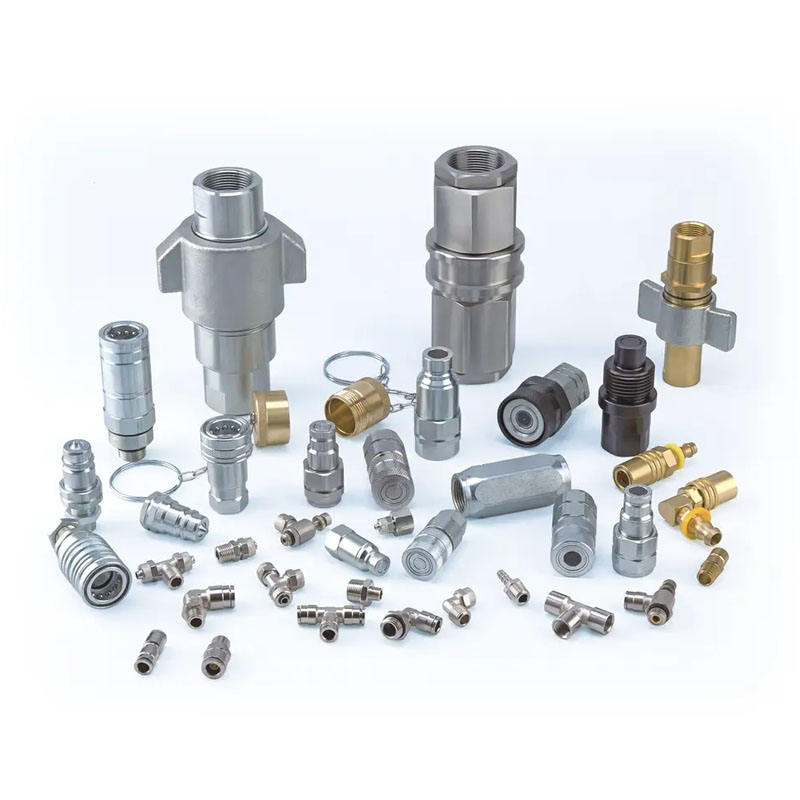
Key Pressure Ratings for Standard Industrial Couplings:
| Coupling Type | Common Material | Max Working Pressure (PSI) | Recommended Safety Factor |
|---|---|---|---|
| Standard Industrial (1/4") | Brass / Steel | 3000 - 4500 | 4:1 |
| High-Pressure Hydraulic (1/2") | Steel / Stainless Steel | 5000 - 10,000+ | 3:1 |
| Pneumatic (Standard) | Brass / Aluminum | 150 - 250 | N/A |
Picture a food processing or chemical plant where hot cleaning cycles alternate with cold product flow. Standard Buna-N seals in a quick coupling become brittle and crack in the cold, then degrade rapidly in the heat, leading to leaks, contamination, and frequent, unplanned maintenance. Temperature cycling is a silent killer of poorly specified components.
Raydafon's Solution: Our technical support team specializes in solving thermal challenges. We assess both fluid media and ambient temperature ranges. For such demanding environments, we supply couplings with advanced seal materials like Viton® or PTFE, paired with bodies constructed from temperature-stable stainless steel or specialty alloys. This engineered approach extends service life by orders of magnitude, protecting your product purity and maintenance budget.
Temperature Ratings Based on Seal Material:
| Primary Seal Material | Standard Temperature Range | Fluid Compatibility Note | Ideal Application |
|---|---|---|---|
| Buna-N (Nitrile) | -30°C to +100°C | Good for oils, water | General industrial |
| Viton® (FKM) | -20°C to +200°C | Excellent for fuels, chemicals | High-temp, chemical |
| PTFE (Teflon®) | -70°C to +260°C | Universal resistance | Extreme temp, ultra-pure |
Q: What are the pressure and temperature ratings for standard quick couplings?
A: There is no single "standard" rating, as it depends heavily on size, material, and design. For common 1/4" brass industrial couplings, typical maximum working pressure is 3000 PSI with a temperature range of -20°C to +120°C using Buna-N seals. Always consult the manufacturer's specifications for the exact model. Raydafon provides detailed, certified data sheets for every product to eliminate guesswork.
Q: How do I choose a coupling for an application with both high pressure and high temperature?
A: This is a critical engineering challenge. The solution lies in selecting couplings specifically designed for combined extremes. Look for forged steel or stainless-steel bodies with high-grade seals like Viton® or Kalrez®. At Raydafon, we offer product lines engineered for these harsh conditions and provide application engineering support to validate your selection, ensuring safety and durability.
Specifying the correct quick coupling is more than a purchase; it's an investment in system reliability. By understanding pressure spikes and temperature cycles, and choosing a partner with deep engineering expertise, you can avoid costly failures. Raydafon Technology Group Co.,Limited is that partner. With a commitment to precision engineering and certified quality, we provide more than components—we deliver solutions that keep your operations running smoothly and safely.
For expert guidance on your specific application requirements, including detailed answers to "What are the pressure and temperature ratings for standard quick couplings?" for our product lines, visit our resource hub at https://www.agricultural-gearbox.org or contact our engineering support team directly at [email protected].
Smith, J., 2021, "Fatigue Life Analysis of High-Pressure Quick-Connect Couplings under Pulsating Loads," Journal of Pressure Vessel Technology, Vol. 143, No. 4.
Chen, L. & Watanabe, K., 2020, "The Effect of Temperature Cycling on Elastomeric Seal Degradation in Fluid Couplings," Polymer Testing, Vol. 91.
Davis, R., 2019, "Standardization of Pressure Ratings for Industrial Hydraulic Couplings," Fluid Power Society Transactions, Issue 78.
Park, S. H., 2022, "Computational Fluid Dynamics (CFD) Modeling of Pressure Drop Across Various Quick Disconnect Coupling Designs," International Journal of Mechanical Sciences, Vol. 214.
Müller, F., et al., 2018, "Material Selection for Couplings in Aggressive Chemical Environments at Elevated Temperatures," Materials & Design, Vol. 155.
Johnson, P. T., 2023, "Safety Factors and Burst Pressure Testing Protocols for Fluid Power Connectors," Safety Engineering Review, Vol. 12, No. 1.
Li, Y., & Garcia, E., 2020, "Leakage Mechanisms in Quick-Acting Couplings Subjected to Thermal Expansion Mismatch," Sealing Technology, Vol. 2020, No. 5.
Kawasaki, T., 2021, "Development of a Low-Pressure Loss, High-Flow Rate Quick Coupling for Agricultural Machinery," Journal of Terramechanics, Vol. 96.
O'Brien, J. A., 2019, "Review of International Standards (ISO, SAE) Governing Coupling Performance Ratings," Standards Engineering, Vol. 71, No. 3.
Zhang, W., 2022, "Predictive Maintenance for Hydraulic Couplings Using Vibration and Pressure Transient Analysis," Mechanical Systems and Signal Processing, Vol. 168.