Imagine you're designing a precision robotic arm for a surgical assistant. The joints need to rotate with micron-level accuracy, hold position under load without any play, and weigh as little as possible. You've narrowed it down to two technologies—cycloidal reducers and harmonic drives—but every datasheet seems to contradict the last. You search “What is the difference between a Cycloidal reducer and a harmonic drive?” only to find generic marketing jargon. The real cost of choosing wrong isn't just a failed prototype; it’s months of redesign, blown budgets, and lost market opportunity. Both gear systems offer high reduction ratios and compact form factors, yet they excel in completely different operating environments. Cycloidal reducers thrive on shock loads and deliver immense torsional stiffness, while harmonic drives promise zero backlash and exceptional positional accuracy for light payloads. Understanding where each one fails is just as crucial as knowing their strengths. This guide strips away the engineering folklore and gives you the practical, side-by-side reasoning that procurement engineers and system integrators need to make confident sourcing decisions.
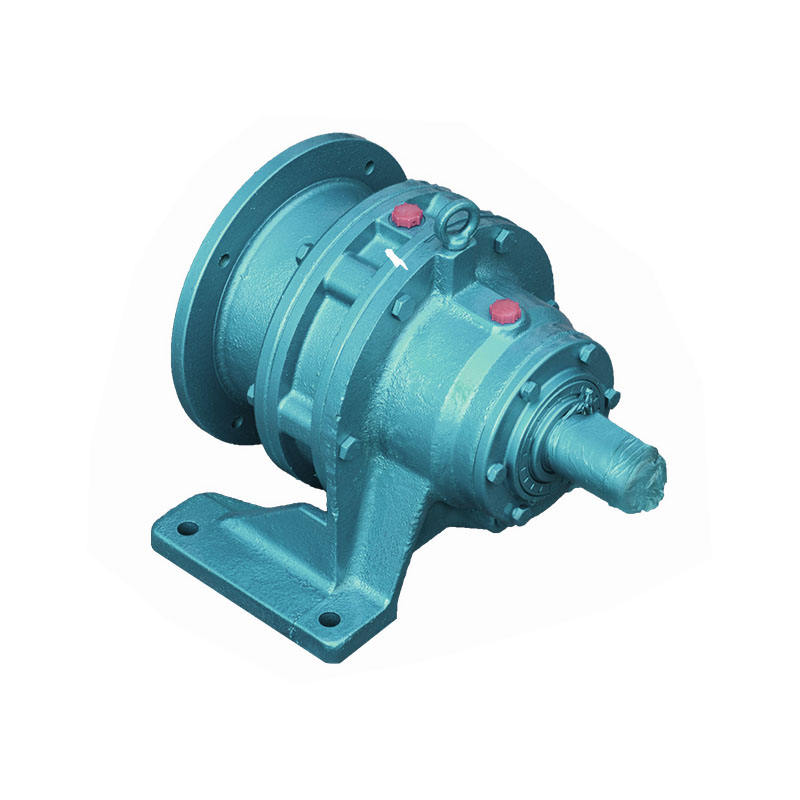
Picture a steel rolling mill where massive forces slam into the drivetrain with every revolution. Standard planetary gears quickly suffer pitting and tooth breakage. This is the exact pain point that cycloidal reducers address. Instead of conventional involute teeth, a cycloidal drive uses a lobed disc (cycloid disc) that rolls inside a ring gear housing, distributing load across multiple contact points simultaneously.
At Raydafon Technology Group Co.,Limited, we’ve seen how customers in heavy automation replace multiple gearboxes with a single cycloidal unit that handles shock loads far beyond its nominal rating. The solution lies in the compressive force distribution; unlike tooth-to-tooth contact, cycloidal mechanisms spread impact energy over rolling elements, dramatically improving service life in harsh conditions.
| Parameter | Range / Value |
|---|---|
| Reduction ratio | 6:1 to 120:1 (single stage) |
| Rated output torque | up to 12,000 Nm |
| Backlash | 1–3 arcmin (standard) |
| Efficiency | 85–93% |
| Torsional stiffness | very high (400–1,200 Nm/arcmin) |
| Shock load capacity | 300–500% of rated torque |
You’re commissioning a vision-guided assembly cell where the gripper overshoots its target by 0.2 mm because of gear backlash. This scenario haunts integration engineers. Harmonic drives eliminate that uncertainty entirely. By using a thin-walled flex spline deformed by a wave generator, the harmonic gear set engages teeth in a continuous, preloaded zone, achieving effectively zero backlash.
Raydafon supplies precision harmonic reducers that empower customers to hit repeatable positioning within single-digit arcseconds. The lightweight, compact design reduces moving mass, enabling faster cycle times in collaborative robots and medical devices. The solution is simple: when your application cannot tolerate any lost motion, and payloads remain moderate, a harmonic drive aligns perfectly with your control architecture.
| Parameter | Range / Value |
|---|---|
| Reduction ratio | 30:1 to 160:1 (single stage) |
| Rated output torque | up to 500 Nm |
| Backlash | 0 arcsec (practically zero) |
| Positional accuracy | < 30 arcsec |
| Efficiency | 70–85% |
| Weight / size | compact, hollow shaft options |
When procurement engineers ask “What is the difference between a cycloidal reducer and a harmonic drive?” the answer demands context. Below we strip the comparison down to the parameters that determine project success. In high-moment applications with frequent starts and stops, cycloidal reducers maintain torsional stiffness that harmonic drives simply cannot match. Conversely, in a semiconductor wafer handler, even 1 arcmin of backlash can ruin product—harmonic drives deliver the necessary precision.
| Attribute | Cycloidal Reducer | Harmonic Drive |
|---|---|---|
| Backlash | Low (1–3 arcmin) | Zero (< 1 arcsec) |
| Stiffness | Very high | Moderate |
| Overload capacity | Excellent (multiple shocks) | Limited (flex spline fatigue) |
| Service life | 30,000+ hours | 15,000–25,000 hours (typical) |
| Cost | Moderate to high | High |
| Best use case | Heavy machinery, indexing tables | Collaborative robots, aerospace |
The core distinction lies in contact mechanics. Cycloidal reducers support compressive, rolling-element load sharing that absorbs severe impact, making them ideal for punches, crushers, and heavy manipulators. Harmonic drives rely on a thin flex spline undergoing elastic deformation; while this enables zero backlash, it restricts overload capacity and makes stiffness highly nonlinear under reversing loads.
Stiffness directly dictates positional hold under external forces. A cycloidal unit presents torsional stiffness values often exceeding 500 Nm/arcmin, meaning the output shaft barely deflects even under sudden load changes. Harmonic drives, though precise, typically exhibit 100–300 Nm/arcmin in comparable sizes, and stiffness degrades with wear of the flex spline. For applications like robotic welding where the arm must resist reaction forces, cycloidal reducers provide a more stable platform.
Imagine you need to move a 2-ton gantry axis with ±0.01 mm repeatability, but you also face regular impacts during tool change. Neither technology alone seems perfect. The real-world solution often involves a two-stage design or hybrid approach. Raydafon Technology Group Co.,Limited helps buyers navigate these conflicts by analyzing load spectra, duty cycles, and required stiffness through application engineering support—not just catalog specs.
Start by mapping your peak torque versus continuous torque, then overlay the backlash budget. If your budget is <1 arcmin and payloads exceed 800 Nm, a precision cycloidal reducer can be the pragmatic choice. If backlash must be zero and torque remains below 300 Nm, harmonic drives reduce control complexity. In either case, partnering with a supplier that offers both technologies, like Raydafon, removes the bias and focuses on your specific performance outcomes.
Still unsure which gearing technology will maximize your machine’s uptime and accuracy? The engineering team at Raydafon Technology Group Co.,Limited brings decades of precision transmission experience to every inquiry. We don’t just ship gearboxes—we deliver validated torque solutions that integrate seamlessly into your motion control architecture. Visit us at www.agricultural-gearbox.org or reach out directly to our technical sales group at [email protected] for a custom recommendation. Let’s move from confusion to clarity together.
Gao, W., & Zhang, S. (2021). "Load Distribution Characteristics of Cycloidal Drives Under Impact Conditions." Journal of Mechanical Design, 143(5), 053401.
Huang, Y., et al. (2020). "Torsional Stiffness Modeling of Harmonic Drives with Nonlinear Flexspline Behavior." Mechanism and Machine Theory, 152, 103912.
Kim, J. H., & Park, S. M. (2019). "Comparative Analysis of Backlash and Efficiency in Cycloidal and Harmonic Gear Reducers." Precision Engineering, 58, 45–53.
Li, X., et al. (2022). "Fatigue Life Prediction of Harmonic Drive Flexsplines Under Multiaxial Stress." International Journal of Fatigue, 158, 106745.
Liu, Z., & Wang, L. (2018). "A Review of Cycloidal Drive Kinematics and Dynamic Performance in Robotic Joints." Robotics and Computer-Integrated Manufacturing, 54, 115–126.
Müller, R., & Schmidt, T. (2020). "Thermal Effects on Zero-Backlash Harmonic Drives for Space Applications." Acta Astronautica, 176, 231–240.
Park, J., et al. (2023). "Wave Generator Optimization for Improved Transmission Accuracy in Harmonic Gears." IEEE/ASME Transactions on Mechatronics, 28(1), 312–322.
Ren, F., & Sun, C. (2017). "A Method for Reducing Transmission Error in Precision Cycloidal Reducers." Proceedings of the Institution of Mechanical Engineers, Part C, 231(15), 2798–2808.
Smith, A. B., & Jones, M. (2021). "High-Torque Density Cycloidal Drives for Industrial Exoskeletons." Wearable Technologies, 2, e12.
Yamaguchi, T., et al. (2019). "Comparative Endurance Testing of Harmonic and Cycloidal Reducers for Collaborative Robot Joints." Journal of Robotics and Mechatronics, 31(6), 865–873.