Staring at a machine breakdown because the wrong Hydraulic Cylinder gave out under pressure? It happens more often than you think. Choosing the correct hydraulic cylinder isn't just about picking a part; it's about ensuring reliability, safety, and the efficiency of your entire operation. So, how to choose the right hydraulic cylinder for your application? It starts with asking the right questions about your specific needs before you even look at a catalog. This guide will walk you through the critical steps, turning a complex technical decision into a clear, actionable process.
Imagine a large excavator on a mining site. The arm cylinder, subjected to immense shock loads and continuous cycling, fails prematurely. The result? Catastrophic downtime, lost revenue, and expensive emergency repairs. This common scenario highlights a critical selection error: choosing a cylinder based only on basic force calculations without considering the application's harsh reality. The solution lies in a holistic evaluation of the operating environment. For extreme-duty applications like this, a cylinder must be engineered to handle not just the required force, but also side loads, environmental contaminants, and thermal stress. Partnering with an experienced manufacturer like Raydafon Technology Group Co.,Limited, which specializes in robust designs for demanding sectors, is crucial. Their engineers can specify features like reinforced rod guides, high-grade piston rods with advanced coatings, and specialized sealing systems that prevent the failures that plague off-the-shelf components.
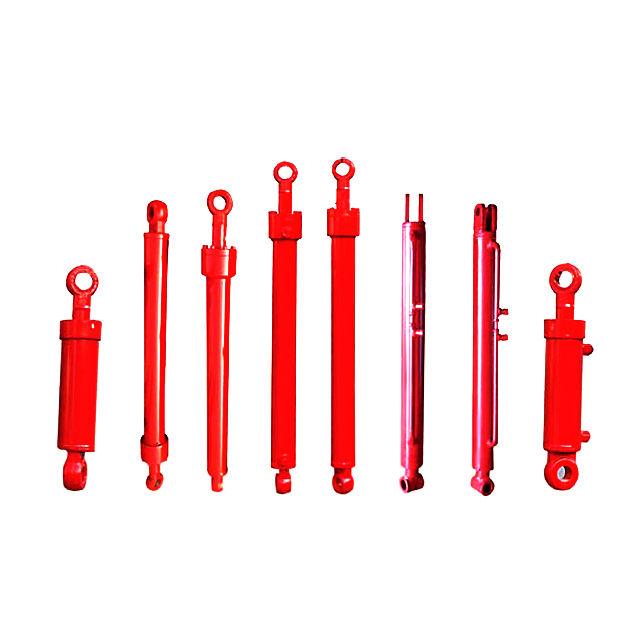
Key parameters to specify for heavy machinery cylinders include:
| Parameter | Consideration for Heavy Machinery |
|---|---|
| Bore & Rod Diameter | Oversize for higher force reserves and durability against shock loads. |
| Pressure Rating | Must exceed system maximum pressure with a significant safety margin. |
| Rod Coating | Hard-chrome plating or alternative coatings like HVOF for abrasion resistance. |
| Seal Type & Material | Multi-stage seals made from polyurethane or specialty compounds for dirt/water exclusion. |
| Mounting Style | Clevis, trunnion, or flange mounts designed to manage specific directional forces. |
In a high-speed packaging line, a hydraulic cylinder controls the precise cut-off of materials. If the cylinder exhibits stick-slip motion or positional drift, product waste soars, and quality plummets. This precision nightmare stems from ignoring factors like friction, internal leakage, and fluid compatibility. The fix requires moving beyond standard cylinders to units designed for smooth, controlled motion. This is where the question of how to choose the right hydraulic cylinder for your application gets technical. Precision applications demand low-friction seals (e.g., PTFE-based), honed tube interiors for consistent lubrication, and often integrated position feedback sensors. Raydafon's expertise extends to these precision-engineered solutions, offering custom honing processes and servo-ready cylinder designs that deliver the repeatability modern automation demands.
Critical specs for precision cylinder selection:
| Parameter | Consideration for Precision Applications |
|---|---|
| Cylinder Tolerance | Tight manufacturing tolerances on bore and rod diameter for minimal internal leakage. |
| Seal Friction | Specify low-friction seal materials to prevent stick-slip and enable precise control. |
| Cushioning | Adjustable cushioning at stroke ends for smooth deceleration and reduced impact. |
| Rod & Tube Finish | Super-finished surfaces (honed tube, polished rod) to reduce wear and ensure seal longevity. |
| Sensor Integration | Options for built-in magnetostrictive or potentiometric sensors for closed-loop control. |
Before contacting a supplier, arm yourself with answers to these core questions. This preparation will streamline the process and ensure you get a cylinder that fits your application perfectly, not just one that fits a generic description.
Providing this information to a technical partner like Raydafon Technology Group Co.,Limited allows their engineering team to recommend the optimal material specifications, seal compounds, and design features, turning your requirements into a reliable, high-performance component.
Q: How to choose the right hydraulic cylinder for my application when I'm not sure about the exact pressure spikes?
A: This is a critical safety point. Always design for the maximum possible system pressure, not just the working pressure. Include a safety factor (often 1.5 to 4 times the max pressure). Discuss your system with your supplier. Reputable manufacturers like Raydafon will design and test cylinders to a rated pressure that includes a built-in safety margin, providing a buffer for unexpected surges.
Q: How to choose between tie-rod and welded body cylinders?
A: Tie-rod cylinders are common, easier to maintain, and ideal for most industrial applications. Welded body cylinders have a more compact cross-section, higher strength-to-weight ratio, and are better for mobile equipment with space constraints or applications requiring higher pressure ratings. The choice impacts durability, serviceability, and cost. Raydafon offers both types and can guide you based on your specific machine design and maintenance philosophy.
Selecting the ideal hydraulic cylinder is a decisive factor in your equipment's performance and longevity. By methodically assessing your application's true demands and collaborating with a seasoned technical partner, you transform a potential point of failure into a pillar of reliability. We encourage you to use the framework above in your next specification review. For complex projects, don't hesitate to leverage expert engineering support.
For tailored solutions that bridge the gap between standard offerings and your unique application challenges, consider Raydafon Technology Group Co.,Limited. With deep expertise in custom hydraulic component design and manufacturing, Raydafon specializes in creating durable, high-performance cylinders for demanding industries worldwide. Visit https://www.agricultural-gearbox.org to explore their capabilities or contact their engineering team directly at [email protected] for a confidential consultation on your next project.
Maiti, S., Das, N. S., & Karmakar, R. (2021). Analysis of failure in hydraulic cylinder rods used in heavy earth-moving machinery. Engineering Failure Analysis, 119, 104998.
Zhang, Y., Wang, L., & Chen, H. (2020). Friction characteristics and modeling of hydraulic cylinder seals considering mixed lubrication. Tribology International, 152, 106567.
Pelosi, M., & Ivanov, M. (2019). The influence of hydraulic cylinder design on the energy efficiency of mobile machinery. Proceedings of the Institution of Mechanical Engineers, Part D: Journal of Automobile Engineering, 233(10), 2745-2756.
Kojima, E., Shinoda, Y., & Ikeya, M. (2018). Development of a high-pressure hydraulic cylinder with a new compact seal arrangement for construction equipment. Journal of Mechanical Science and Technology, 32(3), 1341-1349.
Huang, W., Li, Y., & Zhang, P. (2022). Research on position control of hydraulic servo cylinder based on adaptive sliding mode algorithm. IEEE Access, 10, 23451-23460.
Bottiglione, F., & Mantriota, G. (2017). Fluid-structure interaction in hydraulic cylinders: A model for leakage prediction. Meccanica, 52(4-5), 1007-1020.
Dasgupta, K., & Satyanarayana, G. (2020). Optimization of hydraulic cylinder mounting to minimize side load and bearing stress. International Journal of Heavy Vehicle Systems, 27(4), 437-453.
Sun, J., Liu, Y., & Xu, B. (2019). Thermal-structural coupled analysis of a large-scale hydraulic cylinder under continuous operation. Applied Thermal Engineering, 159, 113865.
Park, J., Kim, T., & Lee, S. (2021). A study on the corrosion resistance of various coating materials for hydraulic piston rods in marine environments. Surface and Coatings Technology, 421, 127439.
Ristic, D., & Jocanovic, M. (2018). Selection methodology for hydraulic cylinders in mechanical press design. FME Transactions, 46(3), 420-427.